

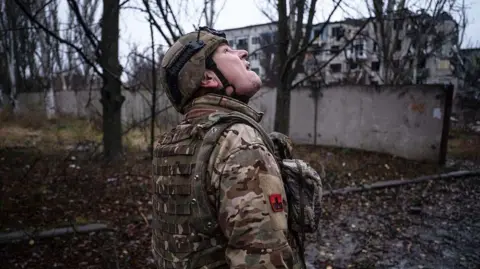
Deep inside what soldiers grimly refer to as the “kill-zone” along Ukraine’s eastern front, modern warfare has evolved into something almost unrecognizable compared to traditional battlefield combat. In this contested stretch near Kostyantynivka, constant drone surveillance and precision strikes have transformed the frontline into a lethal, ever-watching environment where even the smallest movement can trigger instant detection and attack.
This area is now defined less by trenches of opposing armies and more by an invisible technological net in the sky. Both Ukrainian and Russian forces rely heavily on drones for reconnaissance, targeting, and direct strikes. As a result, the battlefield has become a continuous surveillance zone where survival depends on remaining unseen rather than simply holding ground.
One Ukrainian infantryman, whose experience highlights the extreme conditions of this war, was stranded in a frontline position for 225 days. Cut off from regular rotation due to the constant presence of enemy drones, he gradually became physically weakened from isolation, lack of movement, and extreme environmental stress. When his unit repeatedly attempted to rotate him out, each effort failed because drone activity made safe extraction nearly impossible.
Eventually, after months of waiting, he made a desperate decision to leave on foot. Over the course of two days, he traveled approximately 11 kilometers through dangerous terrain filled with landmines and monitored airspace. He moved only when necessary, hiding whenever drones passed overhead and carefully avoiding open ground. His escape was not a coordinated military operation but a survival journey through a battlefield that never sleeps.
The region is currently defended by Ukraine’s 93rd Mechanized Brigade, one of the units tasked with holding back Russian advances toward strategic urban centers in the Donbas region. Kostyantynivka and surrounding towns are considered critical defensive positions. Military analysts warn that if these locations were to fall, Russian forces could gain operational access to deeper Ukrainian strongholds such as Kramatorsk and Sloviansk, potentially threatening the entire remaining Ukrainian defensive structure in the region.

From Moscow’s perspective, control of Donbas remains a central strategic objective. Russian leadership has repeatedly emphasized the importance of securing the region, and Ukrainian intelligence assessments suggest that preparations for renewed offensive operations are ongoing. Ukrainian officials believe that another large-scale push may be attempted during the summer months, aiming to break through weakened defensive lines.
However, the pace of Russian territorial gains has recently slowed compared to earlier phases of the conflict. Independent monitoring groups and battlefield analysis suggest that advances in recent months have been significantly smaller, indicating that the front line is becoming increasingly stabilized. This does not mean the fighting has eased; rather, it reflects the growing difficulty of conducting large territorial operations under heavy drone surveillance and artillery counterfire.
The defining feature of this phase of the war is the dominance of drones. Traditional battlefield tactics involving mass infantry movements or armored columns have largely been replaced by small, highly mobile units operating in fragmented engagements. In many cases, only two or three soldiers move together at a time, often traveling on foot, motorcycles, bicycles, or even improvised transport methods in attempts to avoid detection.
Soldiers describe the “kill-zone” as a wide, desolate strip of land stretching between opposing forces, where nearly every movement is tracked from above. Drones equipped with thermal imaging and real-time video feed operators on both sides maintain near-constant observation. Once movement is detected, artillery strikes or loitering munitions can be deployed within moments, leaving little opportunity for escape.
In this environment, speed and concealment have become more important than armor. Heavy vehicles, once central to warfare, are now highly vulnerable due to their visibility. As a result, even logistical movements such as troop rotations or supply deliveries require careful timing and often occur under cover of darkness or poor weather conditions.
Ukrainian troops stationed within the kill-zone often spend extended periods in foxholes, basements, or heavily damaged structures. Some remain in position for weeks or even months without rotation. These soldiers are tasked not only with defending territory but also with simply maintaining presence in areas that are under constant surveillance and attack. Their role is as much about endurance as it is about combat.
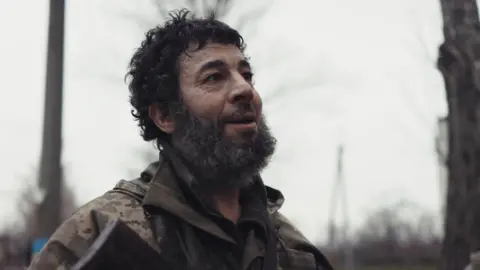
Living conditions in these positions are extremely harsh. Food, water, and ammunition supplies are often delivered by drones, but these deliveries are unreliable. Some drones are intercepted, jammed, or destroyed before reaching their destination. As a result, frontline soldiers frequently face shortages of basic necessities. Water, in particular, is described as one of the most critical and scarce resources.
Soldiers also face environmental hardships that compound the dangers of combat. Winters in the region can drop to minus 25 degrees Celsius, making survival in shallow dugouts or damaged buildings extremely difficult. Sleeping bags and basic protective gear often provide insufficient insulation against frozen ground and exposed concrete shelters.
One soldier described moments of rare relief during rainfall, when he briefly stepped outside to wash after prolonged isolation underground. Such moments are uncommon and often overshadowed by the constant threat of detection from overhead drones.
In addition to direct combat and environmental challenges, psychological stress plays a significant role in frontline survival. Soldiers report constant anxiety, as the sound of drones overhead often signals imminent danger. Even periods of silence can be deceptive, as enemy surveillance may already be in place without visible indicators.
There have also been numerous accounts of close-range engagements inside destroyed buildings and underground positions. In some cases, Russian forces have attempted to clear Ukrainian positions using drones carrying explosives or chemical agents intended to flush defenders out of hiding. When positions are compromised, fighting becomes extremely close and chaotic, often involving grenades, mines, and small arms fire in confined spaces.
Some Ukrainian defenders have survived such assaults through improvised tactics, including hidden escape routes dug in advance or rapid counterattacks against incoming drone systems. In one case, a drone equipped with fiber-optic guidance entered a basement position but became entangled in its own cable, allowing defenders to disable it and disrupt the attack.
Despite these moments of resilience, the overall environment remains extremely dangerous. Even when direct fighting is not occurring, the combination of surveillance, artillery range, and environmental exposure means that no position can be considered safe for long.
Ukrainian military leadership continues to adapt its strategy to this evolving form of warfare. Efforts are being made to disrupt Russian supply lines, targeting logistics routes, ammunition depots, and drone operation centers. These actions are intended to slow offensive momentum and reduce the effectiveness of sustained attacks.
International defense analysts note that both sides are rapidly adapting to drone-centric warfare, making this conflict one of the most technologically dynamic and deadly in recent history. Yet despite the increasing role of machines and remote systems, one fundamental reality remains unchanged: territory cannot be held without soldiers physically present on the ground.
As a result, infantry units like those in Ukraine’s 93rd Brigade continue to occupy forward positions within the kill-zone, enduring conditions that blend traditional trench warfare with modern technological surveillance. Their presence ensures control of territory, even in an environment where visibility means vulnerability and survival depends on invisibility.


0 Comments